No product makes artificial turf as cool as grass, and every number below is the manufacturer's own. With that said, the options that publish the biggest reductions are moisture-based infills: BrockFILL wood infill (at least 20°F cooler than rubber when dry, 40°F or more when moist, per Brock), Limonta GEO / Geo Coolfill cork-and-coconut infill (up to 30°C lower per Limonta; up to 40° cooler with irrigation per Hellas) and HydroChill-coated sand (30–50°F lower in Arizona, per a distributor brochure). Infrared-reflective yarns such as SYNLawn HeatBlock (up to 20% cooler) and TigerTurf TigerCool (up to 15%, up to 10°C) are smaller but work wet or dry and need no upkeep. Penn State's independent testing is the reality check: full turf systems differed by 12°F or less in its lab trial, and all of them topped 150°F. For a New Jersey field, pick a combination, then keep a heat policy.
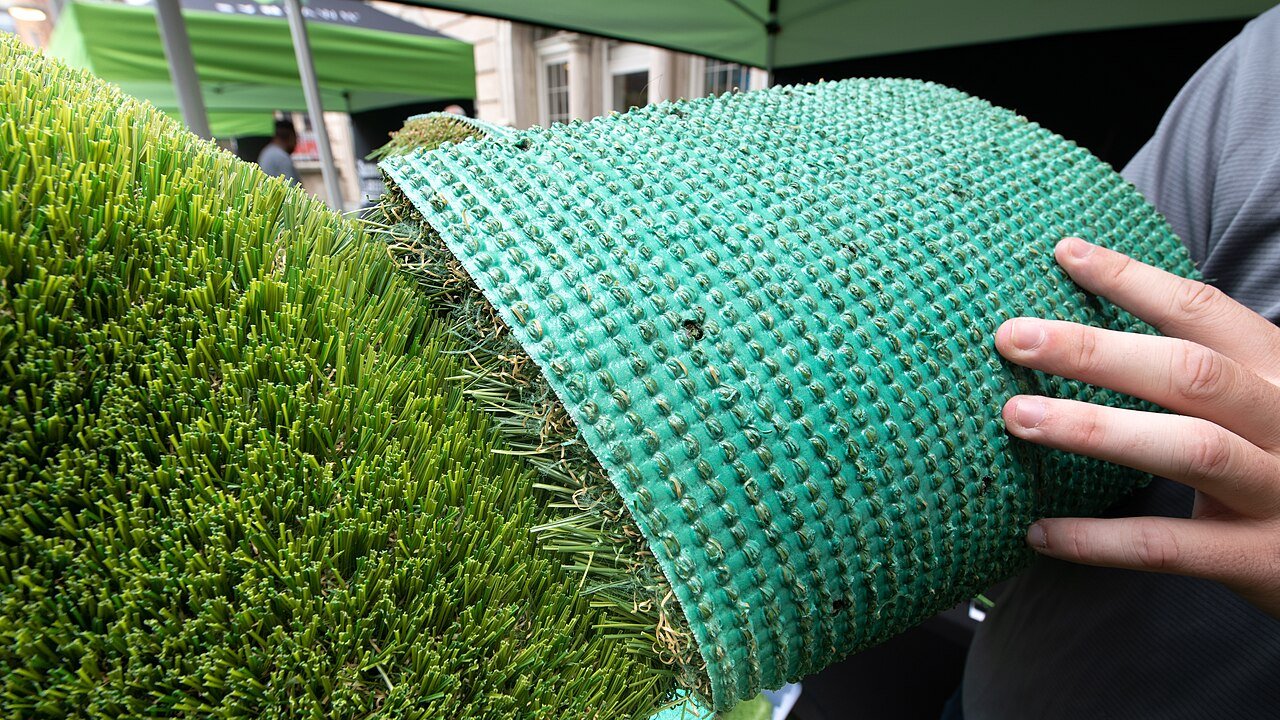
Synthetic turf is plastic fiber over a backing, usually with infill packed between the fibers. On a clear summer afternoon, dark fibers and dark infill absorb solar radiation and turn it into heat, and there's no evaporating plant tissue to carry that heat away the way natural grass does. Brock, one of the infill makers below, says crumb-rubber turf fields can exceed 175°F under intense summer conditions. Our turf cooling systems guide explains the general levers (infill color, irrigation, coatings, shade and airflow). This page goes one step further and compares the named products on the market, on what their makers actually publish.
Heat-reducing products fall into three groups, and they work in different ways:
We did not test any of these products. We don't publish prices, and we don't rank one maker above another. DreamFields maintains, cleans and repairs existing fields; we don't sell any of these turf or infill lines, and no maker paid to be listed.
| Product | Type | Maker's heat claim (as published) | Compared against | Needs moisture? | Typical use |
|---|---|---|---|---|---|
| SYNLawn HeatBlock (and DualChill IR in Super Yarn) | IR-reflective yarn | Up to 20% cooler surface temperatures | Other / comparable turf products | No | Residential, landscape, some athletic |
| TigerTurf TigerCool (TenCate yarn) | IR-reflective yarn | Up to 15% cooler and up to 10°C | Turf without TigerCool; solar-panel tests on film samples | No | Landscape (e.g. Serenity 30 / 40) |
| BrockFILL | Organic wood infill | At least 20°F cooler than rubber dry; 40°F+ when moist; one dry side-by-side reading 33°F cooler | Crumb rubber fields | Works dry; best moist (no scheduled irrigation required, per Brock) | Sports fields |
| Limonta GEO / Geo Coolfill | Cork + coconut fiber infill | Up to 30°C lower (Limonta); up to 40° cooler with proper irrigation (Hellas, Geo Coolfill) | Traditional artificial turf systems | Yes, for the headline figure | Sports fields |
| FieldTurf CoolPlay, PureFill (cork), PureGeo (coconut) | Composite top dressing / organic infills | "Heat Reduction: Yes"; no figure published | Not stated | Not stated (PureFill and PureGeo listed as added maintenance) | Sports fields |
| Envirofill (USGreenTech) | Acrylic-coated quartz sand | As much as 25% lower surface temperatures | Not stated in the one-pager; maker positions it against crumb rubber | No | Sports, landscape, pet |
| HydroChill | Moisture-activated coating on sand infill | 30–50°F lower in Arizona; 50° lower in lab and field thermocouple testing | Standard synthetic turf surface | Yes (rain, dew or irrigation) | Landscape and sports (most infilled systems, per brochure) |
All figures are manufacturer or distributor claims as published, accessed November 2, 2026. Percent figures and degree figures can't be compared directly, and Celsius differences are larger than the same number in Fahrenheit (10°C is 18°F).
SYNLawn introduced HeatBlock around 2009 and describes it as infrared-reflective pigments in the fiber that reduce heat absorption. In its own company history, SYNLawn says HeatBlock "resulted in 20% cooler surface temperatures," and its buyer's guide says HeatBlock keeps surfaces up to 20% cooler than other turf brands and can be combined with heat-reducing infill. The original 2009 launch release credited lab testing by InnovaNet Technology Group and said temperatures were almost 20% lower than ordinary turf. SYNLawn's newer Super Yarn line lists a "DualChill IR Reflective" additive alongside antimicrobial and anti-static additives. SYNLawn doesn't publish an absolute degree figure or a public test protocol for these claims.
Where it fits: backyards, play areas and landscape turf where you're buying new turf anyway. SYNLawn also lists athletic products with HeatBlock.
TigerTurf says TigerCool yarns are made by TenCate with heat-reflective color pigments and UV inhibitors, and that solar-panel tests show turf with TigerCool reduces turf temperatures by 15% and up to 10°C. TigerTurf is unusually candid about the test basis: its US innovation page says the comparative data were collected from 250 μm film samples rather than monofilament fibers or finished carpet, and that indoor infrared-lamp data showed more improvement than outdoor data. TigerCool is used in TigerTurf's Serenity 30 and Serenity 40 landscape grasses, which the maker describes as cooler than many synthetic grasses by up to 15%. A distributor, Synthetic Grass Warehouse, reports its own lab results for TigerCool products of an average 10.5°F and maximum 14°F improvement.
Where it fits: landscape and residential turf. Like any yarn technology, it only comes with new turf.
BrockFILL is an engineered wood-particle infill. Brock says the particles are hydrophilic, absorbing rain and condensation into the core and releasing it slowly so the field cools by evaporation, and that BrockFILL does not depend on a scheduled irrigation system. Its published figures: when dry, a BrockFILL field is typically at least 20°F cooler than a rubber-infilled field; when moist, 40°F cooler or more depending on climate and weather. Brock also describes one side-by-side measurement of two adjacent dry fields with the same turf, same day and time, where the BrockFILL field read 33°F cooler than a crumb rubber field with a cooling agent added, and it notes that results vary by field design, climate, weather and maintenance. Brock says BrockFILL is heavier than cork (about 30% dry, 60% wet), so it is less prone to floating in heavy rain.
Where it fits: sports fields, especially new builds or full infill replacements. Organic infill is part of the shock-attenuation system, so it has to be specified with the right shock pad and approved by the turf maker.
Limonta Sport's GEO is a plant-based infill of cork and coconut fiber. Limonta says the cork provides elasticity while the coconut fibers stabilize the infill and hold humidity that mitigates surface temperature, and that tests show systems with GEO can record temperatures up to 30°C lower than traditional artificial turf systems. Limonta lists several versions (GEO NB, TP, X-TRE 60, Plus and Cork). In the US, Hellas sells it as Geo Coolfill, which its brochure calls a USDA-certified organic cork-and-coconut infill that, with proper irrigation, retains moisture to make the surface up to 40° cooler. Hellas also says it requires irrigation, though far less water than a natural grass field.
Where it fits: sports fields with irrigation or reliable watering. Plan for regular top-ups and grooming; organic infills migrate and break down over time.
FieldTurf's infill page lists three systems marked "Heat Reduction: Yes": CoolPlay, which uses an extruded composite top dressing and is described as keeping the stability of FieldTurf's Elite system "except the heat"; PureFill, a cork infill; and PureGeo, a coconut peat and cork blend. FieldTurf does not publish a temperature figure for any of them on that page. It does list practical trade-offs: CoolPlay requires no underlayment and adds no maintenance, while PureFill requires an underlayment and both PureFill and PureGeo are marked as added maintenance.
Where it fits: FieldTurf fields, typically specified at installation. Ask FieldTurf for test data before relying on a heat number.
Envirofill is a rounded quartz sand with an acrylic coating and pigment. USGreenTech's product sheet says its heat-reducing properties have been proven to lower synthetic surface temperatures as much as 25%, and its crumb rubber guidebook says crumb rubber contributes the most surface heat of the infills it tested. The sheet also lists technical data such as 12–20 mesh sizing, 110 lb/cf density and a non-flammable ASTM E648 rating. Envirofill doesn't need water to do what it does, but its claimed reduction is smaller than the moisture-based options.
HydroChill is a moisture-activated coating applied to sand infill. A HydroChill brochure published by distributor Imperial Synthetic Turf says the coating stores moisture from rain, dew or irrigation and releases it as the surface heats, and that lab and outdoor thermocouple testing showed 50° lower surface temperatures than a standard synthetic turf system; the same brochure and an Arizona installer cite 30–50°F lower surface temperatures in Arizona. The brochure says it can be used in most infilled systems without affecting performance or warranty, and is UV-resistant. Cooling depends on moisture being present, so a dry spell in August means less benefit.
| Project | Start with | Why |
|---|---|---|
| New backyard or play-area turf | IR-reflective yarn (SYNLawn HeatBlock, TigerTurf TigerCool), plus a cooler infill if the system allows | Always on, no upkeep; yarn is only available with new turf |
| New school or municipal sports field | Organic infill (BrockFILL, Limonta GEO / Geo Coolfill, FieldTurf PureGeo / PureFill) or FieldTurf CoolPlay | Largest claimed reductions; must be engineered with the shock pad for Gmax and approved by the builder |
| Field with irrigation or a water cannon | Moisture-based infill (Geo Coolfill, HydroChill) | Their headline figures depend on moisture; irrigation makes them repeatable |
| Field without irrigation | BrockFILL (rain and dew recharge, per Brock) or a non-moisture option (reflective yarn, Envirofill) | Avoid relying on a figure that assumes watering |
| Existing field, mid-life | Operational fixes first: pre-game watering, scheduling and a heat policy | Yarn can't be retrofitted; infill swaps need builder approval and usually wait for replacement |
Is your field running hot?
DreamFields inspects, cleans, decompacts and tops up infill on synthetic turf fields across NJ, NY and CT. We'll measure what you have, check infill depth and Gmax, and tell you honestly what's worth changing now versus at replacement.
Request a field inspection quoteThere isn't one product that solves turf heat. The options that publish the biggest claimed reductions are moisture-based infills, such as BrockFILL wood infill (at least 20°F cooler than rubber when dry and 40°F or more when moist, per Brock), Limonta GEO / Geo Coolfill cork-and-coconut infill (up to 30°C lower per Limonta; up to 40° cooler with proper irrigation per Hellas) and HydroChill-coated sand (30–50°F lower in Arizona, per a distributor brochure). Infrared-reflective yarns like SYNLawn HeatBlock (up to 20% cooler) and TigerTurf TigerCool (up to 15% and up to 10°C) are smaller, always-on improvements. All of these are manufacturer figures, not independent tests.
They are designed to reflect more infrared light so the fiber absorbs less heat, and the makers publish lab or solar-panel results: SYNLawn says up to 20% cooler surface temperatures, TigerTurf says up to 15% and up to 10°C. TigerTurf also notes its comparative data came from 250 μm film samples rather than finished turf, and that indoor lamp results showed more improvement than outdoor tests. Penn State's independent evaluation found that differences between full turf systems were 12°F or less and every system still topped 150°F under its heat lamp.
Generally yes, according to the makers, and the cooling comes mostly from moisture. Brock says BrockFILL absorbs rain and dew into the particle and releases it slowly; Limonta says GEO's coconut fibers hold humidity. Both say cooling is greatest when the infill is moist. In Penn State's lab test of infills alone, black rubber read 156.0°F after an hour under the lamp versus 141.6°F for Ecofill and 136.4°F for TPE, but the gap narrowed once infill was combined with fibers.
It depends on the product. Brock says BrockFILL does not depend on scheduled irrigation and recharges from rain and condensation. Hellas says Geo Coolfill reaches its up-to-40° cooler figure with proper irrigation. HydroChill is moisture-activated, so rain, dew or irrigation is what drives its cooling. Organic infills also need top-ups and grooming that a rubber field may not.
Cooling yarns can't be retrofitted; they're part of the turf carpet, so they only come with a new install or full replacement. Infill can be changed at a full infill replacement or, for some products, topdressed, but you need the turf manufacturer's and field builder's approval first because infill type affects shock absorption (Gmax), drainage and warranty. Watering before play is the only quick retrofit, and our cooling systems guide covers that.
Very hot on sunny days. Brock says turf fields with crumb rubber can exceed 175°F under intense summer conditions, and every system in Penn State's lab trial exceeded 150°F under a heat lamp. That's why heat-reducing products help but don't replace a heat policy: see our guide to when to cancel practice for turf heat.
Related: turf cooling systems · turf heat safety · cleaning turf in summer heat · best shock pads · best playground turf · turf cleaning services
Sources (accessed November 2, 2026): SYNLawn, 20 years history (HeatBlock, DualChill); SYNLawn Artificial Grass Buyer's Guide (PDF); SYNLawn HeatBlock 2009 launch release (reprint); TigerTurf, TigerCool; TigerTurf US, Innovation (test basis); Synthetic Grass Warehouse, TigerCool overview; Brock USA, heat and surface temperature; Brock USA, BrockFILL; Limonta Sport, GEO; Hellas, Geo Coolfill brochure (PDF); FieldTurf, infill systems; USGreenTech Envirofill product sheet (PDF); USGreenTech crumb rubber guidebook (PDF); HydroChill brochure, Imperial Synthetic Turf (PDF); Turf Masters (AZ), infill options; Penn State Center for Sports Surface Research, Synthetic Turf Heat Evaluation progress report (PDF). Hero photo: USDA, public domain, via Wikimedia Commons.