Infilled turf is very good at hiding small things. A drywall screw, a staple from a banner or a bobby pin drops between the fibers, gets pushed into the rubber or sand infill by the next few footsteps, and disappears. Nobody sees it until a grooming brush drags it up, a player kneels on it or a sliding tackle finds it.
That's why magnet sweeping is its own task, separate from routine brushing. Brushing stands fibers up and levels infill. A magnet's only job is to pull out the metal you can't see. This guide covers when a field needs it, how to do it without disturbing the infill, and where it fits in a cleaning plan.
Turf fields don't generate metal on their own. It comes in with people and projects, so it's easy to predict which fields are at risk. The STC's own guidance names several of these situations: it says fields can collect "dirt, debris and metal" despite routine maintenance, tells owners to protect turf during nearby work such as track recoats, bleacher painting and lighting repairs, and says no anchoring spikes, posts or footings should be driven into the turf during events.
If your field had any of these in the last few weeks and hasn't had a magnet pass, assume there's metal in it.
The first concern is people. A screw point-up in the infill is a puncture risk for anyone who dives, slides or kneels, and for younger kids who sit on the field. CDC lists puncture wounds, giving stepping on a nail as its example, as a type of wound that should prompt a call to a healthcare provider about tetanus, and it recommends that everyone stay current on tetanus vaccination. We're not giving medical advice here; the point is that metal in a field turns a routine practice into a first-aid problem.
The second concern is the field. The STC says every loose foreign object, "no matter how small," can damage a field by abrading fibers or contaminating the infill. Hard metal under a groomer gets dragged across the fibers. It can also be pulled into the brushes or sieve of a powered turf cleaner. That's one reason to magnet-sweep before a deep cleaning, not after.
The third concern is liability and paperwork. Many field warranties require a maintenance log, and the STC says each maintenance operation, however minor, should be recorded. A logged magnet pass after an event is a simple record that the field was checked before it went back into use.
The STC doesn't set a calendar interval for magnet sweeping. Its guidelines tie it to circumstances. Here's how we translate that into a schedule:
| Situation | When to sweep | Why |
|---|---|---|
| Graduation, concert or other event with floor protection or staging | Right after the protection is removed, before the field reopens | The STC specifically says to groom and sweep with a magnet once event protection is removed, to catch "misplaced or dropped nails, screws, etc." |
| Fence, bleacher, lighting or scoreboard work | At the end of each work day if the field stays open; always at project close-out | Fasteners and offcuts travel. Covering the field during the work, as the STC suggests, reduces but doesn't eliminate this. |
| Nearby building or roofing project | After the noisy phases (demolition, roofing) and at close-out | Roofing nails and screws blow and bounce farther than people expect. |
| Multi-day tournament | After the event, with the post-event trash and debris cleanup | High traffic, more equipment, more lost hardware. |
| Preseason or semi-annual deep cleaning | As the first pass, before brushing and sieving | Keeps metal out of brushes and sieves and gives you a clean starting point for the season. |
| A player reports finding metal | Before the next session | Where there's one screw there are usually more. |
For the full post-event process, including trash, stains and checking for indentations left by staging, see our guide to post-event turf field cleanup. For projects, see post-construction artificial turf cleanup.
DreamFields cleans, grooms, repairs and inspects synthetic turf fields in Essex County and across NJ, NY and CT. Tell us what's happening on the field and we'll quote the cleanup visit in writing.
Get a QuoteAll magnetic sweepers do the same thing: hold a strong magnet close to the surface so ferrous objects jump up and stick to it. They differ in width, how they're carried and how you clean them.
A walk-behind magnet on two wheels, typically used by roofers and contractors. Fine for a sideline, a bench area or a small backyard putting green, and for spot work after a crew finds something. Too slow to cover a full field.
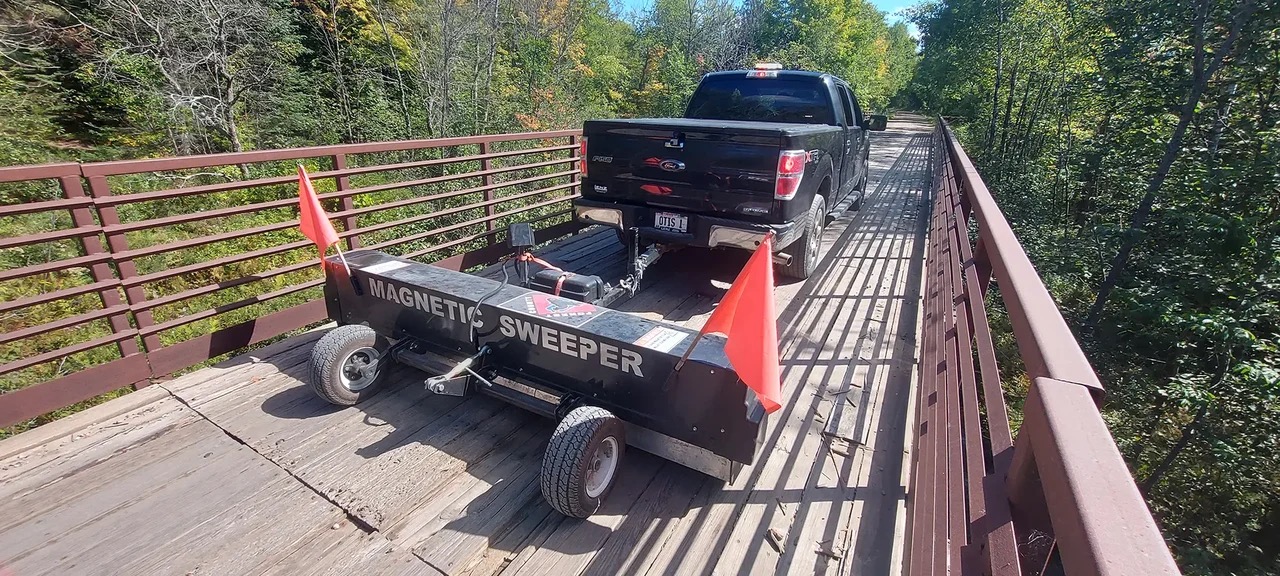
A wider magnet bar on its own wheels, pulled by a utility vehicle or truck. Because the wheels set the height, the bar rides above the fibers instead of on them. This is the common choice for full fields. One example: SportSweeper's MagSweeper 6ft Combo pairs a wheeled rare-earth magnet with a 6-foot friction mat on one hitch, and the maker lists an operating speed of 5 to 10 mph and about 15 minutes for a football field.
Heavier bars that mount to a tractor. Campey's Mega Magnet, for example, is a 6-foot (1,829 mm) three-point-mounted magnet that the manufacturer says is designed for turf areas after events such as concerts. It lists a 20 hp power requirement.
This is what the STC describes: a magnet attached to your existing grooming or brushing equipment, so every grooming pass also collects metal. It's the cheapest way to get regular coverage, as long as the mount is approved and the magnet hangs at the right height.
This is the part people forget. Magnets attract ferrous metal: iron and most steels. Everything else stays in the turf.
So a clean magnet isn't a clean field. The STC's broader cleaning guidance applies: remove waste items regularly, use a sweeper or specialty cleaning equipment for surface debris, and use a blower on low throttle for seeds and shells so you don't move the infill. Glass in particular calls for a hand search of the area where it broke. Our guide to deep cleaning vs. routine maintenance explains how sieving and vacuum equipment fit in.
Sweeping is the backstop. A few habits cut how often you need it:
After a graduation, concert, tournament or construction project, we'll clean, groom and inspect the field so it's ready for play. Essex County, NJ, NY and CT.
Get a QuoteYes, as an as-needed task. The Synthetic Turf Council's maintenance guidelines list metal removal, using a magnet attached to maintenance equipment, as part of comprehensive maintenance, and specifically say to groom and sweep with a magnet after field protection from an event is removed. Fields that host concerts, graduations, construction or fence repairs need it most.
There is no fixed interval in the STC guidelines. Sweep after anything that brings metal onto the field: stage or floor-protection teardown, bleacher or fence work, lighting or construction projects nearby, and big tournaments. Many owners also add a magnet pass to a preseason or semi-annual deep cleaning. Ask your field builder what its warranty expects.
No. Magnets only attract ferrous metal (iron and most steels). Aluminum can tabs and bottle caps, brass shell casings, copper wire and most 300-series stainless steel won't be picked up. Glass, plastic zip ties and sunflower seeds won't either. Those need a mechanical sweeper or a hand walk.
A magnet bar that rides above the surface doesn't touch the fibers. Damage comes from the tow vehicle: sharp turns, sudden braking, spinning wheels or heavy, high-pressure tires. The STC says to use field-builder-approved vehicles, drive slowly, make wide turns and keep heavy vehicles at or below 35 psi tire pressure.
Get first aid and talk to a healthcare provider. CDC lists puncture wounds, such as stepping on a nail, as wounds that warrant consulting a provider about tetanus, and recommends that everyone stay up to date on tetanus vaccination. Then pull the field out of use until it has been swept.
If you have frequent events and a trained operator, owning a tow-behind magnet can make sense. If you need it a few times a year, after a graduation or a construction job, it's usually simpler to add a magnet pass to a scheduled cleaning or post-event cleanup visit. We quote those visits in writing after seeing the field.
DreamFields USA doesn't sell or rent magnetic sweepers, and no manufacturer paid to be mentioned. Equipment examples are for illustration only; confirm any equipment with your field builder before use.
See also: Post-Event Turf Field Cleanup · Post-Construction Turf Cleanup · Best Turf Groomers & Sweepers · Artificial Turf Cleaning Cost