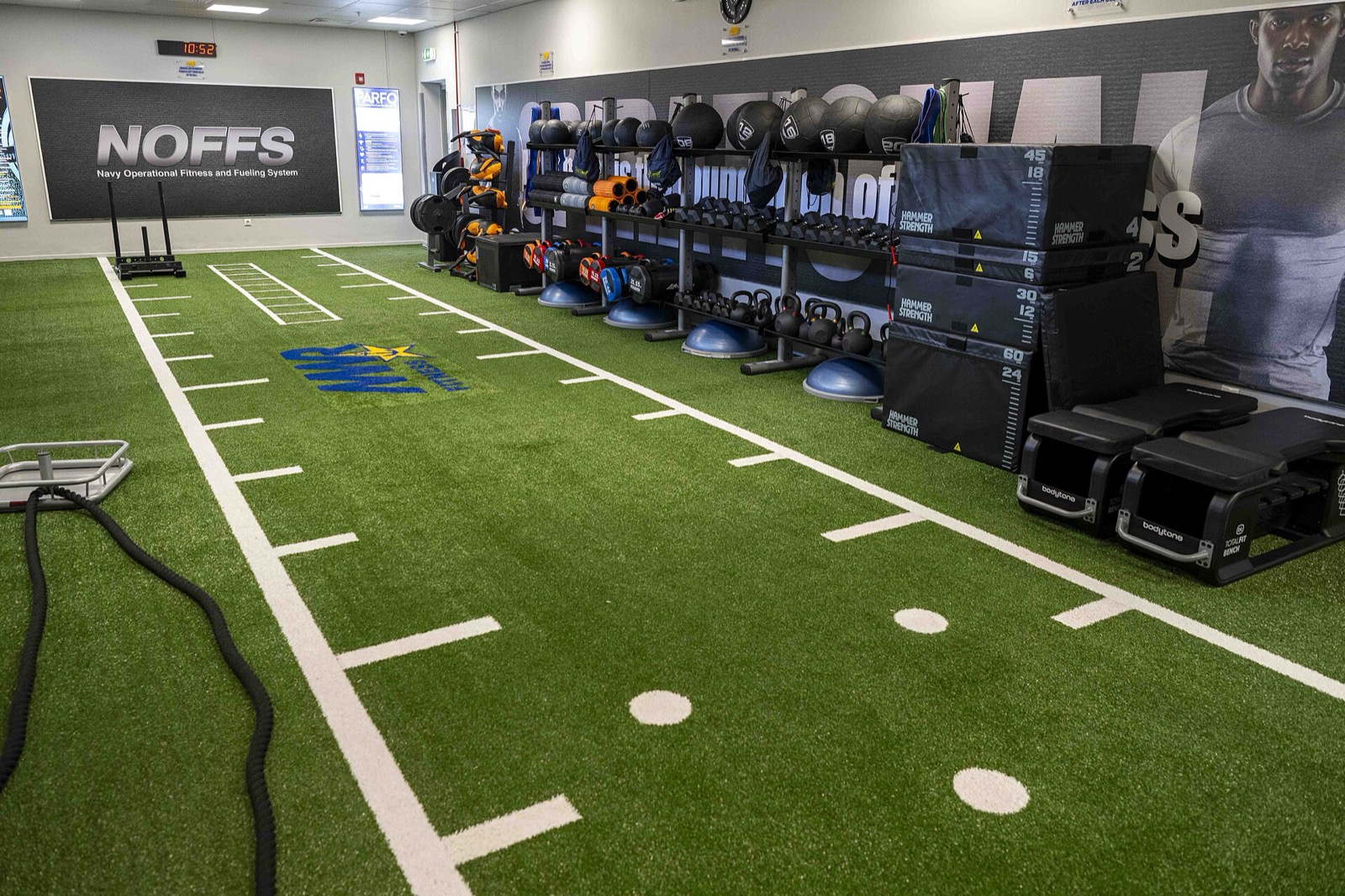
Photo: indoor turf training zone at the Naval Support Activity Souda Bay fitness center, August 2025 (U.S. Navy photo via Wikimedia Commons, public domain; resized). Illustrative gym turf — not a DreamFields project.
Indoor gym turf is a short, dense, usually infill-free synthetic turf, glued or taped over a prepared floor, that gives a training facility a sled lane and an open functional-training zone. A good install starts with the slab, not the turf: test concrete for moisture, fix cracks and high spots, pick glue-down or loose-lay for how the space will be used, and confirm the product's fire-test reports match your building. In New Jersey, fibrous floor coverings must pass the federal pill test in every occupancy, and some locations near corridors and exits also need a radiant-panel rating unless the building is fully sprinklered. DreamFields USA quotes gym turf for Essex County and North Jersey facilities and works on projects nationwide; request a quote with your room size and current floor.
Owners and managers of private training gyms, CrossFit and functional-fitness boxes, physical therapy and sports-performance clinics, school and college weight rooms, municipal recreation centers, and homeowners turning a garage or basement into a training space. If you are adding a sled lane, an agility strip or an open turf zone to an existing building, the questions are the same: what product, what goes under it, how it is attached, and what the building code expects from a floor covering.
If you are planning an outdoor field instead, start with our turf installation overview. If you already have gym turf and need it cleaned or deodorized, see gym and fitness center turf cleaning.
Outdoor sports-field turf uses long fibers held upright by sand and rubber or organic infill, over an engineered stone base that drains. Indoor training turf works differently. The fibers are short and tightly packed so a loaded sled slides across them, cleats are not part of the picture, and there is no rain to drain. Most gym turf is sold to be used without any infill at all.
That difference drives the rest of the decisions:
Most facilities do not turf the whole floor. A common pattern is one long sled lane along a wall, sometimes with a wider open zone for agility, carries and floor work, while rubber flooring stays under racks and platforms. A few planning points come up on almost every job:
Send us the room dimensions, the floor that is there now (bare concrete, rubber tiles, old carpet, wood), how the turf will be used, and any lines or logos you want. We will tell you what the subfloor needs and quote the install.
Request a gym turf quoteGym turf failures that look like product problems are often subfloor problems: ripples from a floor that was not flat, adhesive letting go, or a musty smell from moisture trapped under a glued-down floor. Most of these can be avoided before the first roll is opened.
Concrete gives off moisture, especially on-grade slabs and basements. Installers commonly test slabs with in-situ relative humidity probes (ASTM F2170) or calcium chloride moisture emission tests (ASTM F1869) and compare the results to the limits published by the adhesive and turf manufacturers. If readings are over those limits, the options include a moisture-mitigation coating or a different attachment method. Cracks, saw cuts and high spots need to be ground or patched so the turf does not telegraph them. Our turf over concrete guide covers the outdoor version of this; the indoor slab questions are similar, minus drainage.
Turf over rubber tiles, old carpet or vinyl is possible in some cases and a bad idea in others. Loose rubber tiles can shift under a sled; old carpet can hold moisture and odor; some vinyl and old adhesives have to be removed. If the existing floor is going to stay, the turf manufacturer should approve the build-up.
On a wood subfloor or an upper floor, weight, sound and vibration from dropped weights and sled work become part of the design. That is a conversation for the building owner and, where needed, a structural or acoustical professional, before the turf is ordered.
| Method | Where it fits | Trade-offs |
|---|---|---|
| Full glue-down | Sled lanes and heavy-use commercial floors | Most stable under pushing and dragging; slab moisture must be within adhesive limits; harder to remove later |
| Seam tape + perimeter tape (loose-lay) | Leased spaces, lighter-use zones, home gyms | Easier to remove or relocate; more chance of creep or ripples under heavy sled work |
| Over a separate pad | Spaces that need more cushion for floor work | More comfort; sleds may feel slower; pad and turf must be approved to work together |
The right answer is often a mix: glue the sled lane, loose-lay a stretching area. The turf manufacturer's installation guide sets what is allowed for warranty purposes, so we follow it rather than improvising.
Because turf is a fibrous floor covering, building and fire codes treat it like carpet. Section 804 of the International Building Code, which New Jersey's Uniform Construction Code builds on, has two tests that matter:
The code also says carpet-type floor coverings are to be tested as proposed for use, including underlayment, and that test reports should be available to the fire official on request. In practice, that means asking for the reports for the exact turf and pad you are installing, not a different product from the same brand. Which edition of the code applies, and how your space is classified, are questions for your local construction official.
When you have more than one quote, line them up by product, pad, subfloor prep, moisture testing, attachment method, lines and logos, demolition and disposal, and warranty. Our guide to comparing artificial turf installation quotes in NJ walks through the same checklist for outdoor projects.
Indoor turf does not need the grooming and infill top-dressing that outdoor fields do, but it does collect sweat, chalk, skin cells and dust. Regular vacuuming with a machine suited to turf, prompt cleanup of spills, and periodic deep cleaning keep odor down and fibers standing up. Watch the sled lane for fibers that stay flattened, seams starting to open, and edges lifting at transitions; those are repair calls, not replacement, when caught early. Our indoor turf facility cleaning guide covers the routine.
DreamFields USA quotes indoor gym turf for training facilities, schools, clinics and home gyms in Essex County and across North Jersey, and supports projects nationwide.
Get a gym turf installation quoteMost indoor training floors use a short, dense, non-infill turf (often called gym turf or sled turf) with an attached cushion or a separate pad underneath, rather than the long-pile, infilled turf used on outdoor sports fields. Short, tight fibers let sleds glide and resist the abrasion of pushing and dragging. The right product depends on whether the lane is mostly for sleds, agility and speed work, or general functional training, and on what sits under it.
Yes. Under Section 804 of the International Building Code, which New Jersey's Uniform Construction Code builds on, fibrous floor coverings must pass the DOC FF-1 pill test (16 CFR Part 1630) or ASTM D2859 in all occupancies. In corridors, exit passageways, stair or ramp enclosures, and rooms open to a corridor, they must also meet a minimum ASTM E648 / NFPA 253 radiant-panel class unless the building is sprinklered throughout. Ask the manufacturer for the test reports for the exact product and underlayment, and confirm with your local construction or fire official.
Often, yes, but the slab has to be checked first. Moisture coming up through concrete can break down adhesives and trap odor under a glue-down floor, so installers commonly test the slab, for example with in-situ relative humidity probes (ASTM F2170) or calcium chloride tests (ASTM F1869), and compare the results to the adhesive and turf manufacturers' limits. Cracks, high spots and old adhesive also need to be addressed so the turf lies flat.
Glue-down is the most stable choice for heavy sled traffic, because the turf cannot creep or ripple. Loose-lay with seam tape or perimeter tape is easier to remove for tenants who may move, and can work for lighter-use areas. Many facilities glue the sled lane and treat other areas differently. Follow the turf manufacturer's installation instructions, since the warranty usually depends on them.
Usually not. Most gym turf products are designed to be used without infill. That also avoids tracking rubber granules around the building. Federal research on recycled tire crumb rubber noted that some chemicals were measured at higher levels in air at an indoor field with tire crumb infill than at outdoor fields, which is one more reason many indoor facilities choose infill-free products.
We do not publish a per-square-foot price because the total depends on the product, pad, subfloor prep, moisture mitigation, inlaid lines or logos, demolition of old flooring, and access to the space. Send us the room dimensions, the floor you have now, and how the space will be used, and we will quote it.
Note: This page is general information for gym owners, schools and homeowners planning indoor training turf in New Jersey and elsewhere. It is not engineering, fire-code or legal advice. Code editions, occupancy classifications, accessibility requirements and product approvals depend on your building and jurisdiction — confirm them with your local construction official, fire official and the turf manufacturer. DreamFields USA does not publish prices or invent product specifications on this page; request a site-specific quote for numbers that apply to your project.