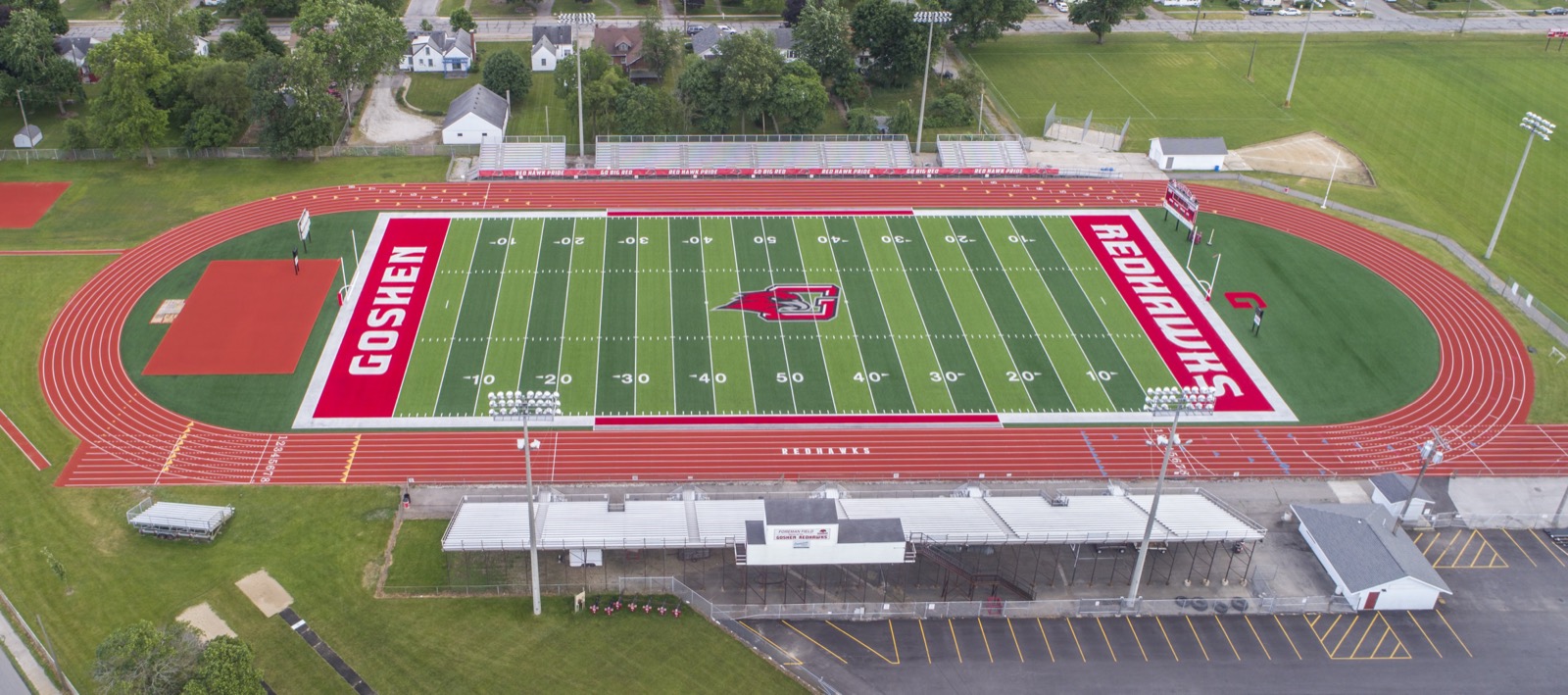
Photo: Goshen High School football field (Wikimedia Commons, CC BY-SA 4.0; resized). Illustrative stadium turf — not a DreamFields project photo.
Replace a football artificial turf field when wear is concentrated across hash marks, player traffic corridors, sideline benches and logo inlays, when serial G-Max and infill checks show the surface is getting harder or thinner, and when repair no longer restores a safe, playable carpet. For New Jersey high schools, recreation departments, towns and clubs — and for districts that also run multi-state programs — the project usually runs in phases: condition assessment, scope writing (including striping and logos), procurement (public bid or cooperative purchasing), installation window, then testing and line work. Do not invent a price from a blog post — get a field walk and a written scope that covers removal, disposal, base inspection, pad, carpet, infill, testing, hash marks and graphics. DreamFields USA works with NJ facilities on assessment and replacement planning and can support projects nationwide; request a quote when you are ready to put dates on a calendar.
This page is for New Jersey athletic directors, school business administrators, town recreation departments, booster clubs and private clubs that already have an artificial turf football field and are deciding whether the next capital project is a repair, an infill refresh, a carpet resurfacing or a full replacement. DreamFields USA also supports facilities outside New Jersey; the wear patterns and testing concepts travel, while procurement language below focuses on NJ public entities. It is not a price list. Synthetic sports-field costs move with fiber system, pad, disposal rules, access, schedule, logo complexity and what the base needs — so any number you see online without a walk of your field is a guess.
If you are earlier in the life of a field, start with our guides on lifespan and replacement signs, G-Max testing and how to compare artificial turf installation quotes in NJ. If the carpet still plays but the lines and logos need a refresh or a multi-sport changeover, see football field marking before jumping to replacement. Soccer programs sharing a complex should also read our sibling guide on soccer field turf replacement in NJ — the capital decision is similar, the wear map is not.
Football concentrates traffic differently than soccer. Hash marks, the alley between the hashes where most plays start, the area between the twenties where offenses live, sideline bench and team zones, and end-zone / midfield logo inlays take repeated cleat, sled and equipment traffic. A field can look green from the press box while the carpet in those corridors is already past a safe repair.
Common field-level signs that repair is no longer enough:
One or two of these in a small area can still be a repair conversation. Several at once across the playing surface is usually a replacement or resurfacing conversation. Our broader seven signs guide covers the same logic for residential and multi-sport fields; football simply concentrates the timeline on the hashes, logos and sideline traffic.
G-Max is an impact-attenuation reading used to describe how hard a synthetic surface feels under a standardized drop test. Higher readings generally mean a harder surface. Facilities use serial testing — the same method, roughly the same map of test points, logged over seasons — to see whether a field is trending harder as fibers wear, infill migrates and any pad underneath ages.
For North American football layouts, the widely cited specification is ASTM F1936, Standard Specification for Impact Attenuation of Turf Playing Systems as Measured in the Field. ASTM's own abstract describes an in-situ free-fall drop test and a maximum impact-attenuation requirement for turf playing systems installed for North American football fields, with sport-specific test-point locations (including areas inside and outside the inbound lines out to sport-specific limit lines). Published summaries of F1936 that we reviewed for this page — including industry explainers that cite the standard directly — describe a maximum G-max of 200 at any individual test point. A field with a point at or above that threshold is treated as noncompliant and should be taken out of service until remediated. ASTM also notes that compliance does not imply an impact-related injury cannot occur.
The Synthetic Turf Council (STC) publishes voluntary Guidelines for the Performance and Quality of Synthetic Turf Fields. Industry sources summarizing the September 2024 revision of those guidelines state that STC recommends G-max remain below 165 for the operational life of the field — a stricter best-practice threshold than the ASTM 200 ceiling, not a legal minimum and not a substitute for your manufacturer warranty or counsel. That gap between 165 and 200 is exactly why athletic directors track trends early instead of waiting for a failed 200 reading in August.
Infill depth is the other number that changes the decision. Too little infill exposes fibers to accelerated wear and can raise hardness. Too much or poorly distributed infill changes footing and traction. A replacement scope should say how depth will be measured before removal, what happens to recovered infill, what new infill system is specified, and how depth will be verified after install. Our G-Max testing guide and infill depth by sport pages explain the variables without treating any one product as a universal answer.
Tell us the school or town, the field size, the age of the carpet if you know it, logo/striping needs, and any recent G-Max or infill reports. We will help you separate repair, resurfacing and full replacement before you publish a bid.
Request a field assessment quoteThese three paths get mixed together in board meetings. Drawing a clean line early keeps the RFP honest — especially when a booster club is fundraising against a headline “new field” number that may actually be a carpet swap.
| Path | When it fits | What usually stays | Watch for |
|---|---|---|---|
| Repair / patch / seam work | Isolated damage, one seam, a small burn or a localized hash-mark or logo patch while the rest of the carpet is healthy | Most of the carpet, pad and base | Repeated patches in the same corridors — a sign the carpet is aging out |
| Carpet resurfacing (often with new infill) | Fibers and backing are worn across the field, but the engineered base and drainage still perform and the pad (if any) still meets criteria | Base, drainage network, sometimes the pad | Hidden base or pad problems discovered after the old carpet comes up; logo seam count on the new system |
| Full replacement | Carpet wear plus base failure, chronic drainage issues, pad failure, or a layout change that needs different geometry or a track/field interface rebuild | Little or nothing above the subgrade — depends on the inspection | Schedule around football season; disposal of old carpet, infill and graphics |
Our quote-comparison guide for NJ explains how to keep bids apples-to-apples when one vendor prices carpet-only and another prices base work. Disposal and recycling of the old system also belong in the scope — see artificial turf disposal and recycling so the bid is not silent on haul-off.
Football carpets carry more permanent graphics than most soccer fields: hash marks, yard lines, numbers, end-zone letters, midfield logos and often multi-sport overlays for lacrosse or soccer. Each inlaid graphic is a seam-management decision. Painted lines are cheaper up front and easier to change; inlaid lines and logos look sharper on broadcast and game day but add seams and future repair points. Your RFP should say which markings are inlaid, which are painted, who supplies artwork, who owns color matching, and how change orders for late logo edits are priced. Our football field marking guide covers the line side in more detail — attach it conceptually to the capital scope so striping is not a surprise allowance after award.
A clean New Jersey municipal or school project usually moves through the same phases whether you are a board of education stadium project or a town recreation field with Friday-night lights. The labels vary; the work does not.
For maintenance RFPs the drafting habits are similar — measurable scope, testing method, documentation — and our turf maintenance RFP guide is a useful companion when the same board is renewing a grooming contract alongside a capital replacement.
New Jersey municipalities generally operate under the Local Public Contracts Law, N.J.S.A. 40A:11-1 et seq. Boards of education operate under the Public School Contracts Law (N.J.S.A. 18A:18A-1 et seq.) and related purchasing rules. Real bid notices for New Jersey athletic-field turf work routinely cite those statutes along with affirmative-action, prevailing-wage, business-registration and public-works contractor registration requirements — for example, municipal notices that reference N.J.S.A. 40A:11-1 et seq. for artificial-turf field installation, and school notices that reference N.J.S.A. 18A:18A bid bonds, consent of surety and DPMC classification where the dollar amount requires it. The exact path for your football field depends on the estimated contract value, your purchasing agent or Qualified Purchasing Agent (QPA), and whether a cooperative (coop) contract already lists a turf system that matches your specification. This page is general information, not legal advice — confirm the path with your counsel or QPA before you publish anything.
Private clubs that are not public entities still benefit from the same specification discipline. Even without a sealed bid, a written scope, site visit and comparable quotes protect a board that has to explain a six-figure field decision to members or boosters.
Most New Jersey high school and municipal football facilities try to avoid taking a primary game field offline between August and Thanksgiving. That pushes many replacements into late fall after the playoff window, midwinter weather windows that still allow install, or late spring / early summer before August camp. Weather, curing time for adhesives, logo inlay labor and the need for post-install testing all eat calendar days — a “two-week install” on a brochure is not the same as “ready for the first scrimmage.” Build a buffer, and have a backup practice site agreement in writing before the old carpet comes up.
Replacement is not finished at substantial completion. Confirm G-Max and infill depth against the specification, walk every seam (especially around logos and hashes), check edges and track transitions, and sign off on line and graphic accuracy before the first contact practice. Then put the field on a grooming and inspection rhythm so the new carpet does not age the way the old one did in the player corridors. Our sports field maintenance guide and maintenance contracts for schools and municipalities cover the operating side once the capital project is closed out.
DreamFields USA helps New Jersey schools, towns and clubs — and facilities nationwide — assess football artificial turf fields and plan replacement, resurfacing and maintenance scopes. Send the field location, your season calendar, logo needs and any recent test reports, and we will put next steps in writing.
Request a quoteHeavy-use high school and municipal football fields often land at the shorter end of the typical synthetic sports-field life range because hash marks, player traffic corridors between the hashes, sideline bench zones and logo inlays take repeated cleat and equipment traffic. Exact years depend on fiber type, maintenance, drainage, multi-sport overlays and how many events the field hosts. Use wear signs plus serial G-Max and infill-depth testing, not calendar age alone, to decide between repair, resurfacing and full replacement.
ASTM F1936 is the widely cited U.S. specification for in-field impact attenuation of turf playing systems, including North American football layouts. Published summaries of F1936 describe a maximum G-max of 200 at any individual test point; a point at or above that threshold is treated as noncompliant and the field should be taken out of use until remediated. The Synthetic Turf Council's Guidelines for the Performance and Quality of Synthetic Turf Fields (revised September 2024, as summarized by industry sources that cite the STC document) recommend keeping G-max below 165 for the operational life of the field — a stricter voluntary industry guideline, not a substitute for your warranty or counsel. Track readings over time with a documented method and treat a rising trend with worn fibers or thin infill as a planning signal.
Often yes, if the stone base and drainage still perform and the shock pad (if present) still meets the project criteria. Carpet-only replacement is common when fibers and backing are worn but the engineered base is sound. Have the base, drainage and pad inspected before you write the RFP, because a hidden base problem turns a carpet swap into a much larger project mid-bid — especially under hash marks and logo inlays where seams and traffic concentrate.
It depends on your purchasing agent or Qualified Purchasing Agent, Local Public Contracts Law (N.J.S.A. 40A:11-1 et seq.) or Public School Contracts Law requirements, the project's estimated cost, and whether a cooperative contract already covers the exact scope you need. Public sealed bidding is common for large capital stadium projects. Cooperative purchasing can shorten lead time when the coop catalog matches the fiber system, pad, testing, logos and disposal you want — but a mismatch forces change orders. Confirm with counsel or your QPA before choosing a path.
At minimum: field dimensions and sport layout (NFHS/NCAA or your preferred markings), fiber and infill system requirements, shock-pad criteria if used, G-Max and other testing deliverables with a football-relevant test-point map, removal and disposal of the existing carpet, base and drainage inspection expectations, hash marks, yard lines, numbers, end-zone letters and logo inlays, warranty terms, schedule windows around your season, and evaluation criteria so bids are comparable. Attach recent G-Max and infill-depth reports when you have them.
No. Resurfacing usually means removing and replacing the carpet (and often the infill), while keeping a sound base and sometimes the pad. Full replacement can include base rework, drainage repair and a new pad when those layers have failed. Logo-heavy football carpets also force earlier conversations about inlaid vs painted graphics and how many seams the new system will introduce.
Note: This page is general information for New Jersey schools, towns and clubs planning an artificial turf football field replacement (and for facilities nationwide facing the same wear and testing questions). It is not engineering, legal, procurement or safety advice. G-Max limits, warranty terms, Local Public Contracts Law / Public School Contracts Law requirements and cooperative purchasing rules depend on your field, your entity and current law — confirm them with your testing vendor, counsel and purchasing agent. DreamFields USA does not invent field prices, hardness thresholds or case studies on this page; request a site-specific quote for numbers that apply to your project.